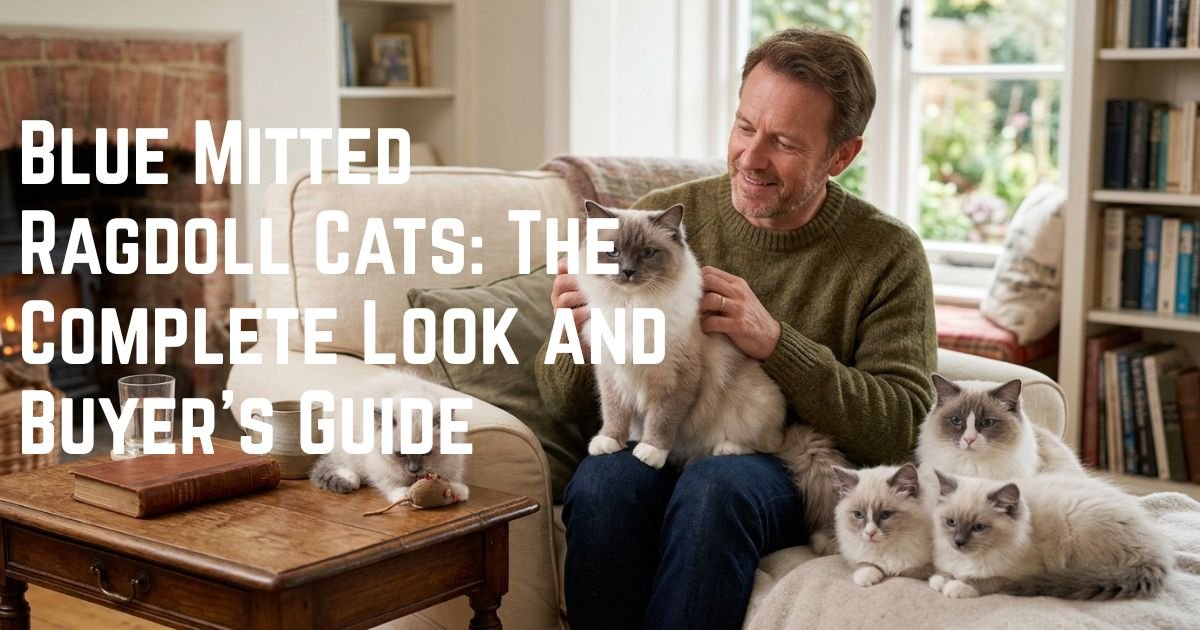
Blue mitted Ragdolls pair cool, slate-gray points with white “mittens” on all four paws and a white chin. Blue is the second most common Ragdoll color after seal, and it’s consistently the most requested color on breeder waitlists, so blue mitted kittens tend to have the shortest availability window even though they’re one of the more common combinations.
What a Blue Mitted Ragdoll Looks Like
The points, meaning the face, ears, legs, and tail, are a cool, slate or steel-gray. The body is a soft, pale gray-white, several shades lighter than the points.
Blue is genetically a diluted version of seal: the same base color gene, run through a separate dilute gene that lightens and cools the tone. That dilution is exactly why blue reads as softer and grayer than seal rather than brown, and why the contrast between points and body is gentler on a blue point than a seal point. Seal carries more pigment overall, so the gap between its dark points and pale body is sharper. Blue has less pigment to begin with, which is why the whole cat reads as more uniform and muted.
Like all Ragdolls, blue mitted cats have blue eyes, and TICA requires that blue eye color for a cat to qualify as a true pointed Ragdoll.
How Blue Point Color Develops
Blue mitted kittens, like every Ragdoll, are born completely white. Color starts appearing on the points within the first one to two weeks, but it comes in gradually. At 8 weeks old, a blue mitted kitten typically shows only a faint gray tint on the ears and tail tip, with the rest of the coat still close to white. It’s easy to mistake an 8-week-old blue kitten for a very pale lilac at this stage, since the color hasn’t deepened enough yet to look clearly slate-gray.
The gray continues to develop through the first year, and by around 12 months most blue mitted cats have reached close to their adult shade. Like the other Ragdoll colors, the final richness and depth of the coat keeps subtly developing until roughly age three. A blue mitted kitten and its three-year-old parent can look like slightly different shades of gray side by side, even though they’re genetically the same color.
Mitted Markings, Explained
Mitted is one of three Ragdoll patterns, sitting between colorpoint (no white at all) and bicolor (the most white). The mitted standard is specific about where white can appear:
- Mittens: white fur covering the front paws, ideally stopping at or just above the ankle
- Boots: white fur running up the back legs, typically higher than the front mittens
- Chin: a solid white chin, distinct from the colored face
- Belly stripe (optional): a thin white line running down the center of the belly, not present on every mitted cat
Marking variance is common and doesn’t mean a kitten is a different pattern. A blue mitted kitten with mittens that run slightly higher on one paw than the other, or a chin that’s only partly white, still has the mitted look buyers are after. That kind of unevenness is a pet-quality vs. show-quality distinction within the mitted pattern, not a sign the cat is actually something else.
Blue Mitted vs. Bicolor: The Visual Tell
This is the mix-up buyers run into most, since both patterns involve white markings. The difference isn’t subtle once you know exactly where to look.
Mitted white stays confined to the paws, chin, and occasionally a thin belly stripe. The face keeps its full gray color except for the white chin. Bicolor white is far more extensive: a white inverted “V” spreads up from the nose between the eyes, the legs are white rather than just the paws, and the underside is white rather than a thin stripe.
The fastest check when you’re looking at a photo: if there’s any white marking on the face beyond the chin, or the legs are white above the ankle, you’re looking at a bicolor, not a mitted, regardless of what the listing calls it.
What to Ask a Breeder About a Blue Mitted Kitten
Since blue is the most-requested color on breeder waitlists, blue mitted kittens can move fast, which makes it worth knowing what to check before committing to one:
- Ask to see both parents’ colors and patterns. A blue mitted kitten needs at least one parent carrying blue and the mitted gene; seeing the parents helps confirm what you’re actually getting, especially since color isn’t fully settled at 8 weeks.
- Ask where the kitten currently sits in its color development. A kitten photographed at 8 weeks will look noticeably paler than the adult color, so ask for a recent photo or a video call rather than relying on early kitten pictures alone.
- Confirm HCM and genetic testing status on the parents, the same as you would for any color or pattern. Blue mitted isn’t a health category, so the same testing standards apply as any other Ragdoll.
- Clarify deposit and waitlist terms up front. Given blue’s demand, many catteries run a waitlist rather than open inventory, so understanding the timeline matters as much as the price.
Frequently Asked Questions
Is blue mitted a common Ragdoll combination?
Blue is the second most common Ragdoll color, and mitted is a frequently requested pattern, so blue mitted kittens are available regularly, though waitlist demand for blue specifically means they don’t stay available long.
Does blue mitted color change with age?
Yes. Blue mitted kittens are born white and the gray points develop gradually over the first year, with subtle deepening continuing until around age three, same as every Ragdoll color.
What’s the difference between blue mitted and blue points?
“Blue point” describes the color alone and can apply to any pattern (colorpoint, mitted, or bicolor). “Blue mitted” specifies both the color and the pattern together.
Ready to bring home a blue mitted Ragdoll? Check current blue mitted availability or browse all Ragdoll colors and patterns.