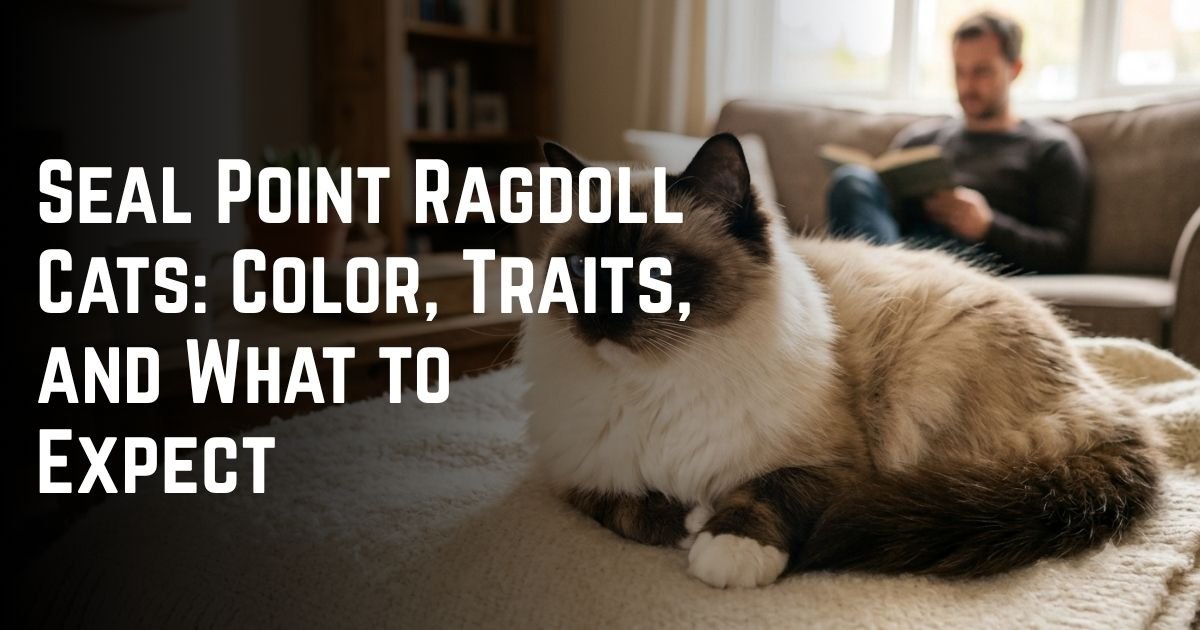
Seal point is the original, classic Ragdoll color: deep brown points set against a lighter, cream-colored body. It’s the most common Ragdoll color and the one most people picture when they think of the breed. Seal point can appear in any of the three Ragdoll patterns (colorpoint, mitted, or bicolor), so “seal point” describes the color, not the amount of white on the cat.
What a Seal Point Ragdoll Looks Like
The points, meaning the face, ears, legs, and tail, are a deep, rich brown that can look almost black in low light. The body is a warm cream or fawn, several shades lighter than the points, which creates the strong contrast seal points are known for. That contrast is actually more pronounced in seal than in any other Ragdoll color. Seal carries the most pigment of the six colors, so the gap between the dark points and the pale body reads more sharply than it does on a blue or lilac point, where there’s simply less pigment difference between the two areas to begin with. It’s part of why seal is often the color people picture first when they think “Ragdoll”: the contrast does more visual work than in the diluted colors.
The nose leather (a cat’s nose skin) is dark brown to match the points, and the paw pads are usually brown or pink-brown. Like all Ragdolls, seal points have blue eyes, and TICA requires that blue eye color for a cat to qualify as a true pointed Ragdoll.
How Seal Point Color Develops: 8 Weeks vs. Adult
Seal point kittens are born completely white, like every Ragdoll kitten. Color starts showing on the points within the first one to two weeks, but at 8 weeks old, a seal point kitten still looks fairly light: you’ll see a soft tan or light brown starting to form on the ears, mask, and tail tip, with the body still pale and the deep brown points nowhere near their final shade.
The brown keeps deepening from there. By one year old, most seal points have reached a color close to what they’ll keep for life, but the full depth of the coat, especially the darkness of the points and the richness of the body tone, continues developing until around age three. A seal point kitten and its three-year-old parent can look like noticeably different shades of brown side by side, even though they’re the same color.
Seal Point in Each Pattern
- Seal Colorpoint: No white anywhere. Full brown points against the cream body, with no white patches.
- Seal Mitted: White mittens on all four paws and a white chin, sometimes with a thin white blaze on the face or a white strip down the belly.
- Seal Bicolor: The most white of the three, with a white inverted “V” on the face, white legs, and a white underside, while the saddle and tail keep the seal brown.
How to Spot a True Seal Point Ragdoll
A few things separate a genuine seal point Ragdoll from a cat that’s simply brown or dark-colored:
- Blue eyes. This is non-negotiable for a pointed Ragdoll. Any other eye color means the cat isn’t a traditionally pointed Ragdoll, regardless of coat color.
- Contrast, not uniform color. A true seal point has a clear difference between the dark points and the lighter cream body. A cat that’s evenly dark brown all over is more likely a solid or sepia-type coat, which TICA classifies separately under the Cherubim breed category, not as a Ragdoll.
- Dark brown nose leather and paw pads, matching the point color.
- TICA or CFA registration paperwork confirming the parents’ colors and the kitten’s pedigree, especially if you’re buying based on color alone.
Seal vs. Chocolate: The Mix-Up to Watch For
Seal and chocolate are the two brown Ragdoll colors, and they get confused constantly, including by sellers who aren’t being careful about labeling. The difference comes down to undertone, not just depth. Seal points run cool, almost a brown that leans toward black in the darkest areas. Chocolate stays warm all the way through, closer to milk chocolate or cinnamon, and it never develops that near-black depth even at full maturity around age three. Side by side, a seal point looks like it has more black mixed in, while a chocolate point looks like it has more red mixed in. If a listing calls a kitten “seal” but the photos show a warm, lighter brown with no cool undertone, it’s worth asking the breeder directly which color is on the registration paperwork.
Frequently Asked Questions
Is seal point the most common Ragdoll color?
Yes. Seal, along with blue, is one of the two foundational Ragdoll colors and the most frequently seen in litters.
Does a seal point Ragdoll’s color ever stop changing?
The color mostly settles by age one, but small changes in depth and richness can continue until around age three.
Are seal point Ragdolls more expensive than other colors?
Not usually. Seal is the most common color, so it typically sits at the baseline price rather than commanding the rarity premium that chocolate, lilac, or red points can carry.
Ready to Bring Home a Seal Point?
Submit an inquiry to check current seal point availability, or browse our other Ragdoll colors and patterns.
Check seal point ragdoll availability · All Ragdoll colors and patterns · Available Ragdoll kittens