
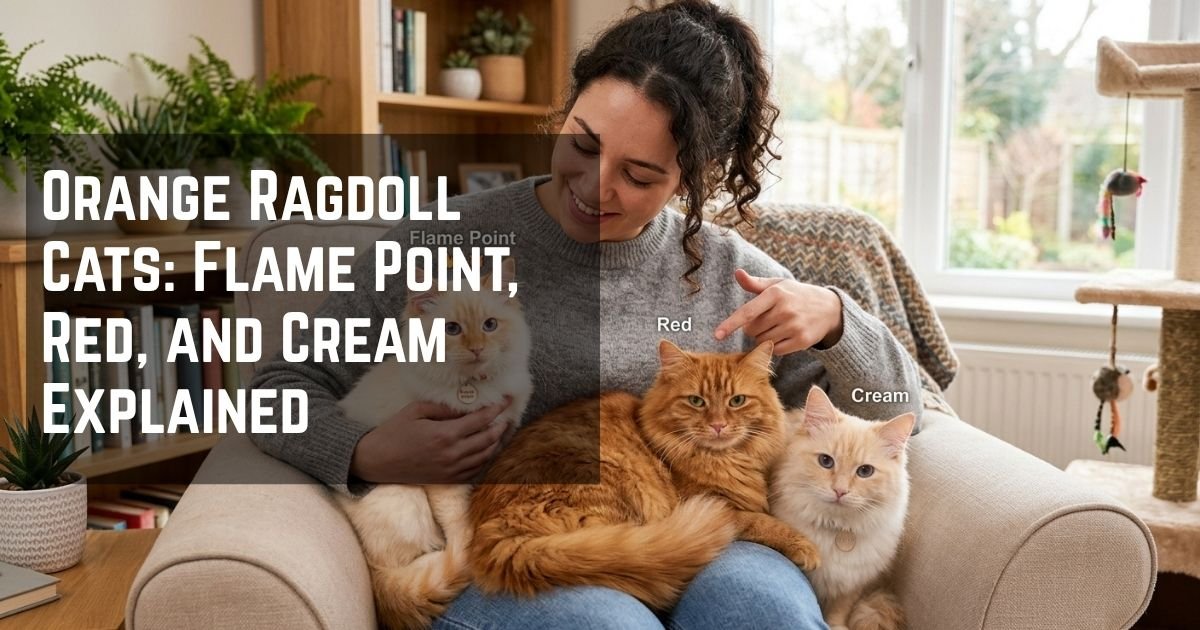
Unlike black or solid white, “orange” Ragdolls are real. The breed terms are flame point (also called red point) and cream, and both are genuine, TICA-recognized Ragdoll colors. If you’ve been searching for an orange Ragdoll, you’re not chasing something that doesn’t exist, you just need the right name for it.
What Flame Point Actually Looks Like
Flame point Ragdolls have warm, reddish-orange points instead of the brown or gray seen in seal or blue. Like every Ragdoll, flame point kittens are born near-white and the color develops on the points over the following weeks.
Genetically, red sits apart from the seal/chocolate and blue/lilac color pairs. It comes from a completely separate pigment pathway, which is part of why it doesn’t fit into the same “myth” category as black or solid white. Red is a real, standalone color gene, not a variation or dilution of the brown-family colors.
One thing worth knowing if you’re specifically drawn to red: male red Ragdolls tend to show more vivid, saturated color than females. This isn’t just a breeder claim, it comes down to how the red gene is inherited on the X chromosome, which produces more consistent, solid coloring in males and more variation (including tortie patterning) in females.
Flame vs. Cream: Which Warm Tone Are You Looking At?
Flame and cream are related the same way blue relates to seal, and lilac relates to chocolate: cream is the diluted version of red. Where flame point gives a bold, warm orange-red, cream produces a much softer, pale tan color from the same underlying gene, run through the dilute gene.
Side by side, flame reads as a clear, saturated orange. Cream reads as a muted, creamy tan, closer to a warm off-white than an orange. If a photo shows strong, warm color on the points, you’re likely looking at flame. If the color is soft and barely there, that’s more likely cream.
Why These Colors Are Less Common
Flame and cream are rarer than seal or blue simply because fewer breeding lines carry the red gene compared to the more common seal/chocolate lineage. That relative scarcity is part of why flame and cream Ragdolls often carry a price premium over the baseline colors, the same rarity economics that apply to lilac.
What to Ask When Buying a Flame or Cream Kitten
Since flame and cream are less common, a few questions help confirm you’re getting a genuine, correctly-identified kitten:
- Ask for the color listed on TICA or CFA registration paperwork. It should say “red point” or “flame point” and “cream point” specifically, not a vague description like “orange” or “ginger.”
- Ask whether the kitten is male or female if color intensity matters to you. Since males tend to show more saturated, consistent red coloring, a breeder should be able to tell you which parent carries the gene and what to expect.
- Request a recent photo rather than a newborn one. Flame and cream kittens are born near-white like every Ragdoll, so an early photo won’t show the true adult color.
- Confirm the price reflects genuine rarity, not inflated demand. A fair premium over baseline pricing makes sense given how uncommon these colors are, but ask what specifically justifies the price if it seems unusually high.
Frequently Asked Questions
Is “orange Ragdoll” a real color or a myth like black?
It’s real. Flame point (red) and cream are both TICA-recognized Ragdoll colors, unlike solid black or solid white, which don’t exist in the breed standard at all.
What’s the difference between flame and red?
Nothing, they’re the same color. “Flame point” and “red point” are used interchangeably to describe the same warm orange-red coloring.
Are male red Ragdolls really more vivid?
Generally, yes. The red gene is inherited on the X chromosome, which tends to produce more solid, saturated coloring in males and more color variation in females.
Interested in a warm-toned Ragdoll? Browse available Ragdoll kittens or see all Ragdoll colors and patterns.