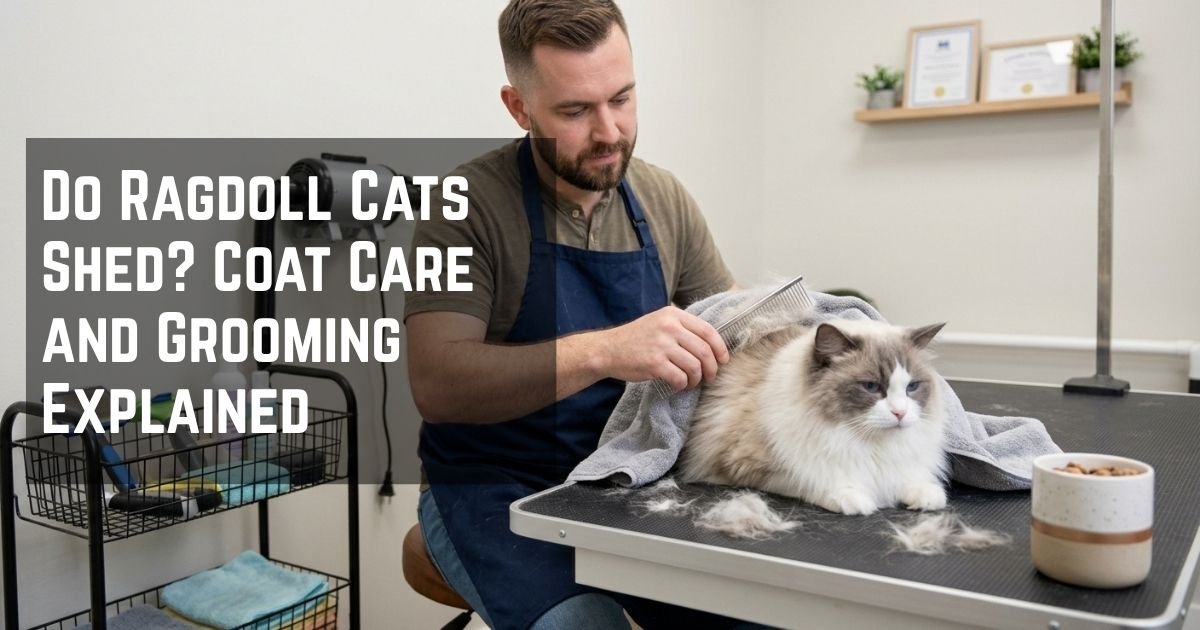
Yes, Ragdolls shed, but moderately, and noticeably less than many other long-haired breeds. According to the Cat Fanciers’ Association’s official breed standard, a Ragdoll’s semi-long coat is made up primarily of guard hairs and shouldn’t carry a significant undercoat, and it’s that missing dense undercoat, not the coat’s length, that keeps both shedding and matting lower than you’d expect from a cat with this much fur.
Why Ragdolls Shed Less Than Other Long-Haired Cats
Most long-haired breeds, like Persians or Maine Coons, carry two coat layers: a longer topcoat and a dense, insulating undercoat. That undercoat is usually the real source of heavy shedding, since it’s constantly cycling and releasing in larger volumes than the topcoat. Ragdolls are built differently. Per the CFA standard, their coat consists mainly of guard hairs without a substantial undercoat, so there’s simply less hair in the shedding cycle to begin with. The tradeoff is a coat that’s less insulating, which is part of why Ragdolls are strictly indoor cats.
When Ragdolls Shed the Most
Shedding follows the seasons. Ragdolls typically shed more heavily in spring, as they release the coat that grew in over winter, and again in autumn, as the coat starts filling in for cooler weather. Between those two seasonal shifts, shedding tends to settle into a lighter, steady baseline. Indoor cats living under consistent artificial lighting can shed somewhat more evenly year-round than the sharp seasonal swings you’d see in a cat with more outdoor light exposure, since coat cycling responds partly to day length.
Preventing Matting and Hairballs
The lack of a heavy undercoat also means Ragdolls are less prone to matting than most long-haired breeds, but “less prone” isn’t “immune.” Mats tend to form in friction-prone spots: behind the ears, under the arms, and around the belly. Regular brushing, a couple of times a week at minimum, catches loose hair before it has a chance to tangle into a mat.
Hairballs are the other predictable byproduct of a shedding long-haired cat. Since Ragdolls groom themselves regularly, loose hair gets swallowed and needs to pass through the digestive system one way or another. Consistent brushing reduces how much loose hair your cat ingests in the first place, which is generally more effective than treating hairballs after they happen.
The Best Grooming Routine for a Ragdoll
A slicker brush or a wide-tooth steel comb works well on a Ragdoll’s coat texture, gently removing loose hair without pulling at the skin. Two to three sessions a week is typically enough to keep shedding under control for most Ragdolls, with more frequent brushing during the spring and autumn seasonal sheds. Diet plays a supporting role here too: omega-3 and omega-6 fatty acids are commonly associated with healthier skin and a coat that sheds more manageably, which is one more reason a quality, protein-forward diet matters for a Ragdoll, something we cover in more depth in our Ragdoll diet and feeding guide.
Coat maintenance is also connected to a question a lot of allergy-conscious buyers ask upfront: whether the lower-shedding coat means Ragdolls are hypoallergenic. It’s worth understanding the real answer to that before assuming a Ragdoll solves an allergy concern entirely.
Frequently Asked Questions
Do Ragdolls shed a lot compared to other cats?
Less than most long-haired breeds. The lack of a dense undercoat means less hair in the shedding cycle overall, though Ragdolls still shed moderately, especially during seasonal transitions.
How often should I brush my Ragdoll?
Two to three times a week is typically enough for most Ragdolls, increasing to more frequent brushing during the heavier spring and autumn seasonal sheds.
Does diet affect how much a Ragdoll sheds?
Yes, to a degree. A diet with adequate omega-3 and omega-6 fatty acids supports skin and coat health, which is generally associated with more manageable shedding, though genetics and season play the larger role.